Determination of Age and Mass for Seismic Stars in the Ariel Input Catalog
The question
A planet is only as well known as its star. Ariel, ESA's survey of the atmospheres of transiting planets, measures each planet against the light of its host, so the host's mass, radius and age must be pinned down first and in the same way for every star (Chapter 1). The dissertation asked how precisely the Bayesian code PARAM can recover the age and mass of Sun-like planet hosts in the Ariel input catalogue, and how much the answer improves when the star's own vibrations, its solar-like oscillations, join the usual spectroscopic and photometric constraints (Chapter 1, Sect. 6.2).
The sample
Three sets of stars were run. First, 13 synthetic stars taken straight from the model grid, with made-up measurement errors, to test whether PARAM recovers what it already knows (Sect. 5.3). Second, 33 Kepler planet hosts from Silva Aguirre et al. (2015), with the large frequency separation Δν, the frequency of maximum power νmax, the temperature and the metal content from Huber et al. (2013), chosen because four other codes had already characterised them (Sect. 6.1).
Third, ten F-G-K seismic planet hosts from the Ariel input catalogue, five of them also in Magrini et al. (2022); their identities were withheld at the consortium's request, so the dissertation calls them Ariel-1 to Ariel-10 (Sect. 6.2).
The method
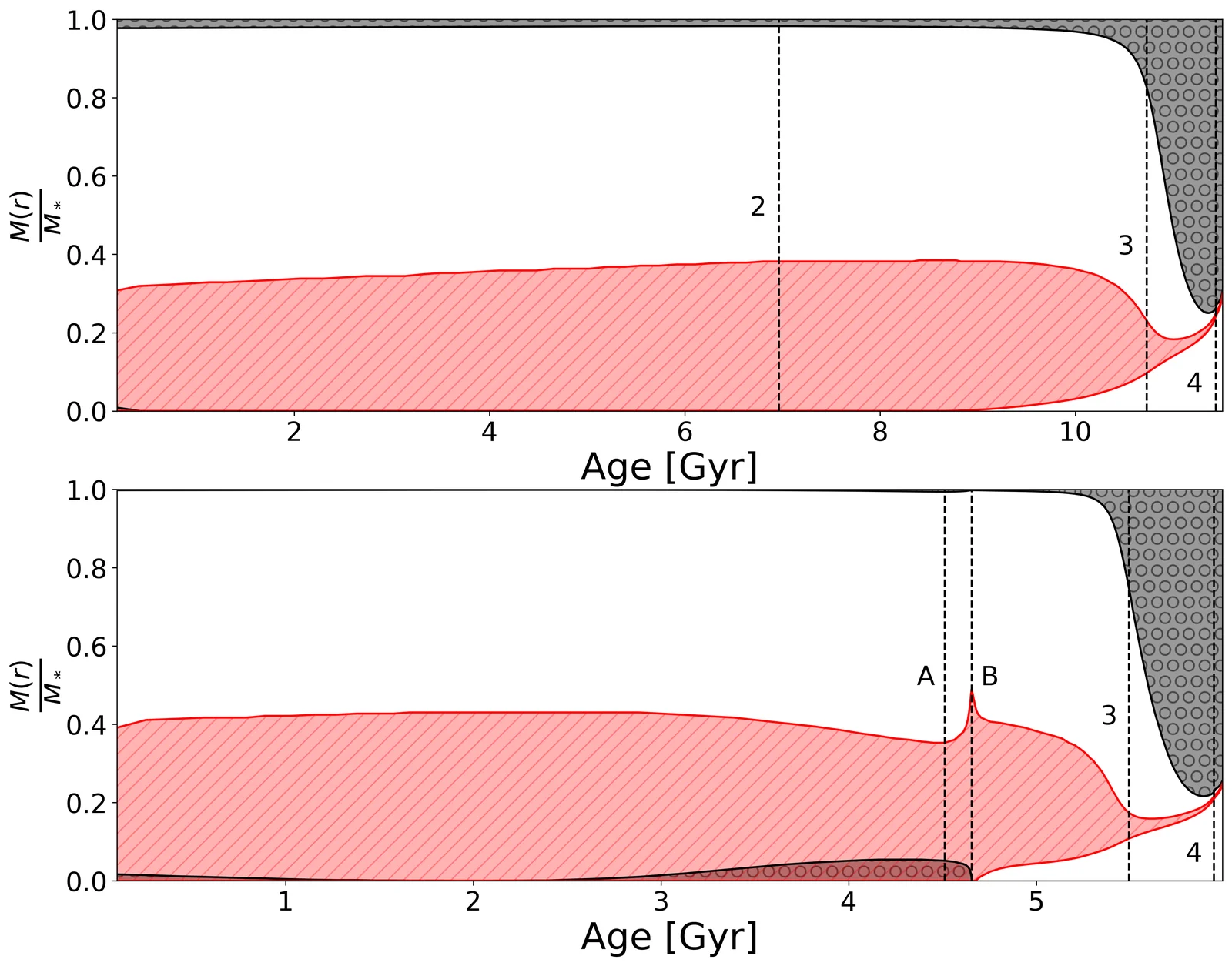
The chain is drawn above. On the model side, a grid of stellar tracks was computed with MESA following the grid D1 physics of Moedas et al. (2022), from 0.5 to 1.8 M☉ in steps of 0.1 and from [M/H] of −0.7 to +0.5 in steps of 0.1, from the zero-age main sequence to the red-giant branch (Sect. 2.6). GYRE then gave each model its oscillation frequencies, from which Δν follows by a weighted regression of the radial modes and νmax from the scaling relation (Sects. 3.3, 5.1 and 5.2).
On the observed side, each star's distance came from its Gaia parallax, its reddening from MWDust with the Green et al. (2019) three-dimensional map, and its luminosity from the 2MASS K band through a BCCode bolometric correction, the band least affected by dust; YBC is introduced as the alternative, and 2,000 Monte Carlo draws show how the input errors reach the luminosity (Chapter 4). Temperature, metal content and surface gravity came from SWEET-Cat 2.0 (Sect. 6.2).
PARAM compares these inputs, with their one-sigma uncertainties, against the grid and returns marginal probability distributions of mass, radius and age, read off as a mode, a median and a 68th-percentile interval; a second peak means a double solution (Chapter 5). Every star was run sixteen times: spectroscopy with or without log g, with or without the luminosity, and with none, one or both of the seismic parameters (Sect. 6.2).
Testing the tool
PARAM passes its own test. On the synthetic stars, the recovered masses, radii and ages fall within their quoted uncertainties, with second-quartile relative accuracies of about 1 per cent in mass and 8 per cent in age for the cluster set (Table 5.1). Ages are hardest for stars below about 0.8 M☉ and for young stars, and stars above about 1.2 M☉ can return two solutions because of the hook in their tracks (Sects. 5.3 and 7).
Against other codes it is less precise. On the 33 Kepler hosts, PARAM, which uses only the two global seismic parameters, reached median relative uncertainties of 4.9 per cent in mass and 26.0 per cent in age, while BASTA, ASTFIT, YMCM and AMP, which fit individual oscillation frequencies, reached 2.7 to 3.4 per cent and 9.6 to 14.6 per cent (Table 6.4).
Its masses agree with BASTA, ASTFIT and AMP to within about 1 per cent, with a 2.2 per cent offset against YMCM, and its ages run 4 to 12 per cent younger than two of the codes (Table 6.3). The dissertation concludes that PARAM is reliable for F-G-K stars but should keep being tested for systematics (Chapter 7).
The results
With the inputs as published, seismology and luminosity are each enough. Starting from spectroscopy alone, median uncertainties of 28.8 per cent in age and 5.3 per cent in mass, adding Δν and νmax brings them to 7.7 and 1.5 per cent, and adding the luminosity instead brings them to 9.2 and 1.2 per cent; adding both changes little more (Table 6.8, Chapter 7).
That result rests on unusually small input errors, 0.6 per cent in temperature and 0.02 dex in metal content, and the dissertation says so. When those errors are inflated to literature-typical values, spectroscopy alone gives 34.1 per cent in age and 5.9 per cent in mass, the luminosity 22.0 and 3.9, the two seismic parameters 19.0 and 4.1, and all of them together 14.1 and 3.3 (Table 6.18, Sect. 6.3).
In this regime the seismic parameters constrain the age better than the luminosity, and the two together do better than either, which the conclusions flag as a contradiction of the first set of findings (Chapter 7). Adding constraints does not always help: for one star they bring out a second solution near 1.3 M☉, where the hook makes the tracks cross (Sects. 6.2 and 7).
What it led to
The dissertation grew out of an FCT MSc research grant on the BreakStarS project at IA, during which I implemented the small-frequency-separation routine, δν02, in PARAM. It put me in the age, mass and radius sub-group of the Ariel Stellar Characterisation working group, where I contributed to Magrini et al. (2022), and it was presented as a poster at ENAA XXXII and a talk at FÍSICA 2022. In 2023 the Faculty of Sciences named me its best master's student in astronomy and astrophysics.