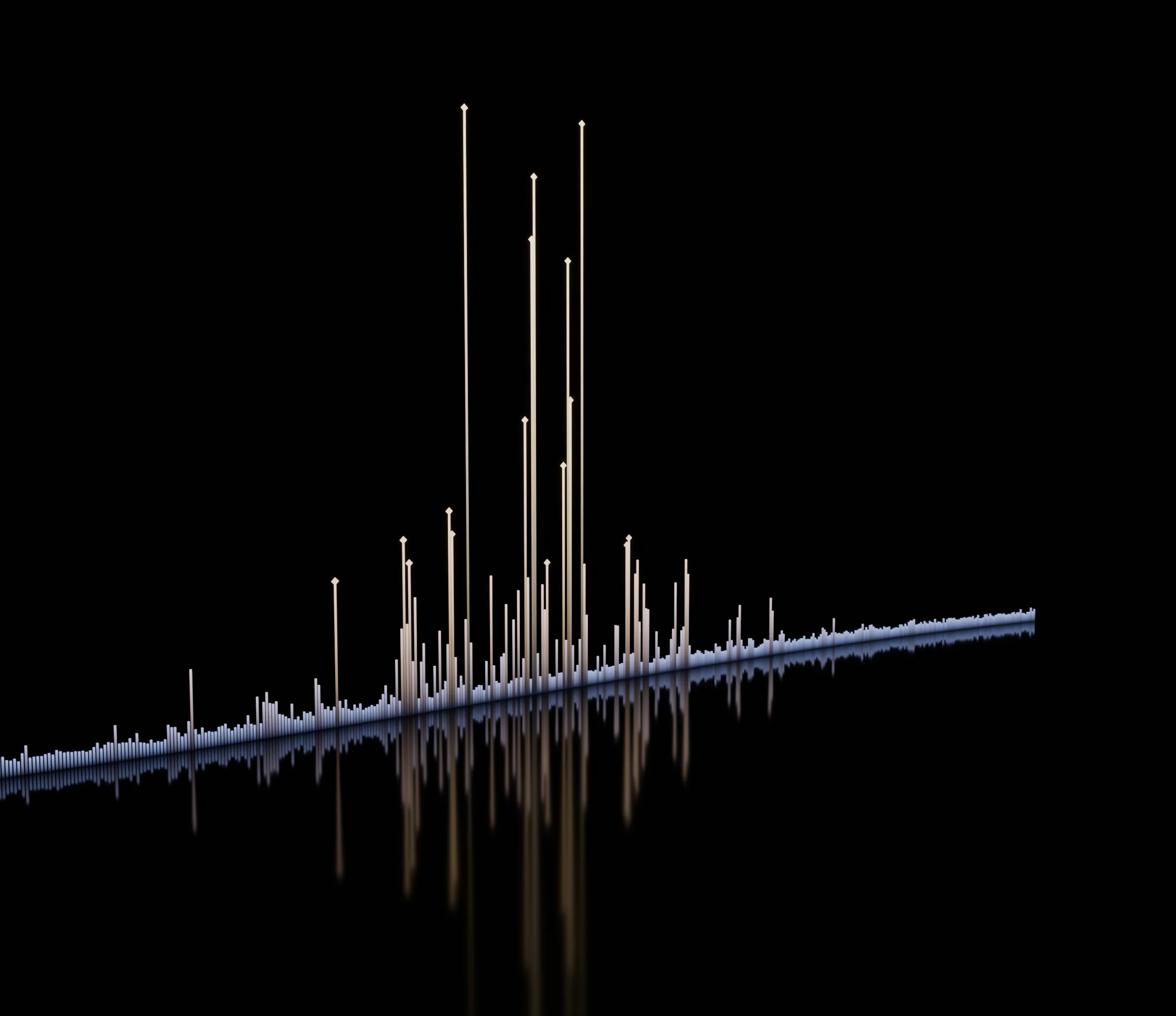
Sound waves travel through the interiors of stars like the Sun and make the whole star vibrate at many frequencies at once. The vibrations change the star's brightness and the speed of its surface by tiny amounts, which space telescopes and precise spectrographs can measure. The frequencies depend on the star's density and internal structure, so they give its radius and mass and, with stellar models, its age.
- νmax
- 3,090 µHz
- Δν
- 135.1 µHz
- Strongest mode
- every 5.4 min
Each tone moves the star's surface in its own pattern and adds a peak to the spectrum. Red is outward displacement, blue inward, exaggerated. The spectrum is a model from the scaling relations, not data.
Scaling relations: Kjeldsen and Bedding 1995, Brown et al. 1991, solar values from Huber et al. 2011. Envelope, visibilities and peak positions: Mosser et al. 2011 and 2012, Broomhall et al. 2009. Background: Kallinger et al. 2014.
In 2001 Bouchy and Carrier used the CORALIE spectrograph at ESO's La Silla Observatory to detect such oscillations in α Centauri A, with surface speeds of up to 35 cm per second and periods near seven minutes. For the 66 main-sequence stars that Kepler observed for at least a year, seven modelling teams later reached average uncertainties of about 2 per cent in radius, 4 per cent in mass and 10 per cent in age (Silva Aguirre et al. 2017).
Where I come in
In 2021 and 2022, as an MSc research fellow, I implemented the small-frequency-separation routine in the stellar characterisation code PARAM. My MSc thesis estimated ages and masses of oscillating stars in the Ariel input catalogue. I co-authored the 2024 ESPRESSO detection of oscillations in the K dwarf ε Indi, where I ran the Bayes-factor test in Appendix D, and the 2026 ESPRESSO study of GJ 570 A and GJ 783 A. Since 2022 I have been a member of the red-giant working group of the Kepler Asteroseismic Science Consortium.