Software engineering
Typed, tested Python packages with continuous integration, locked environments and Sphinx manuals.
Astrophysicist building machine-learning methods for large surveys
I am a fifth-year PhD candidate at the University of Porto and IA, building machine learning for Galactic archaeology. Deep neural networks and unsupervised learning on Gaia and other large surveys let me reconstruct how the Milky Way was assembled. My first-author paper in Astronomy and Astrophysics (2025) led to Starfold, an open-source Python package.
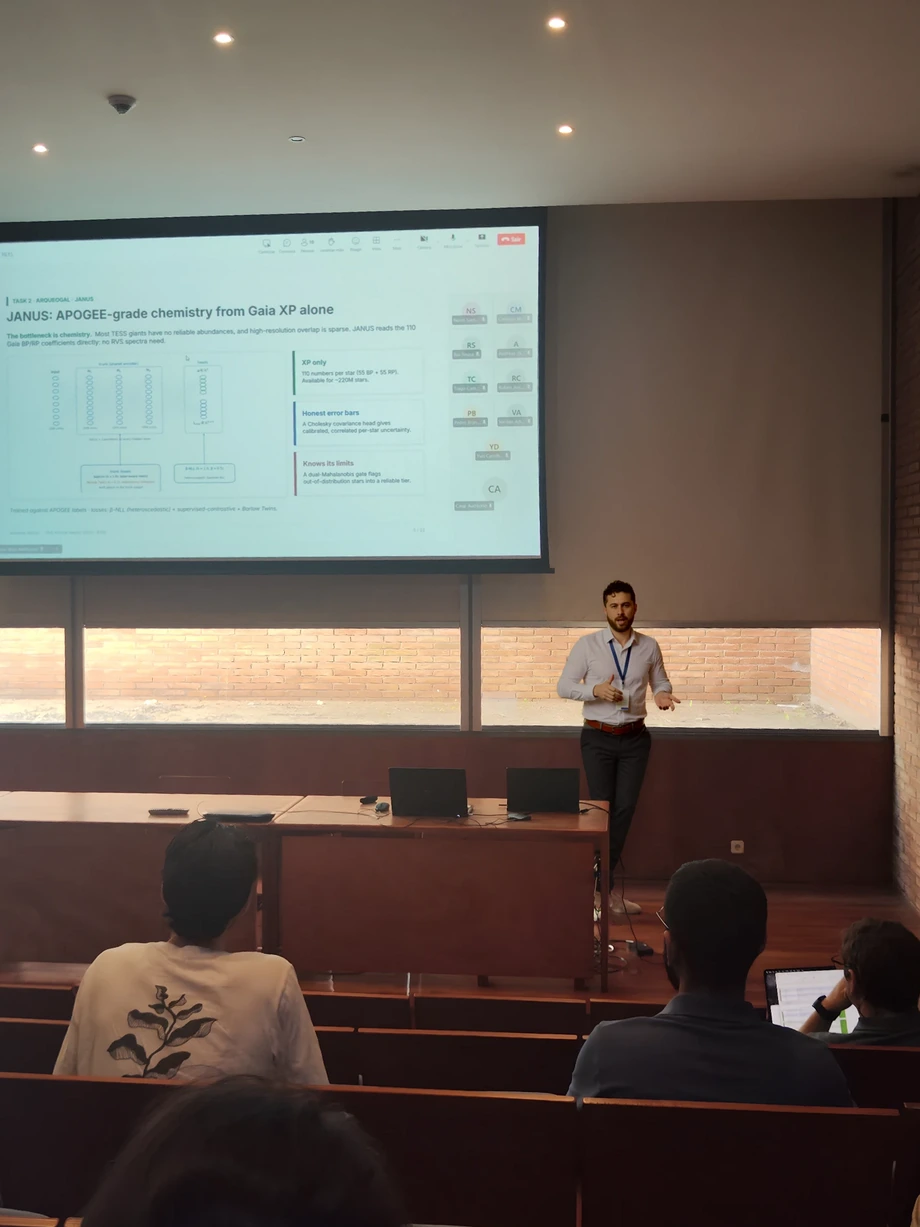
I am principal investigator on two competitive supercomputing allocations, on Deucalion and MareNostrum 5, for JANUS, my neural network for Gaia spectra. I also use Bayesian inference and asteroseismology to measure stellar ages.
Typed, tested Python packages with continuous integration, locked environments and Sphinx manuals.
matplotlib and Plotly figures, and interactive browser applications in WebGL, Canvas2D and SVG.
Normalising-flow ensembles in PyTorch, gradient boosting, manifold learning (UMAP) and density-based clustering (HDBSCAN), with Optuna search.
Isotonic calibration of per-star error probabilities, interval-coverage and selection tests, nearest-neighbour novelty for out-of-distribution stars, and covariance propagation through wavelet projections.
Ingestion of whole Gaia releases into Parquet shards, with manifest-resolved datasets, duplicate checks and provenance on every product.
Slurm on the ARM, x86 and GPU partitions of Deucalion and the University of Bologna clusters, with CUDA and RAPIDS.
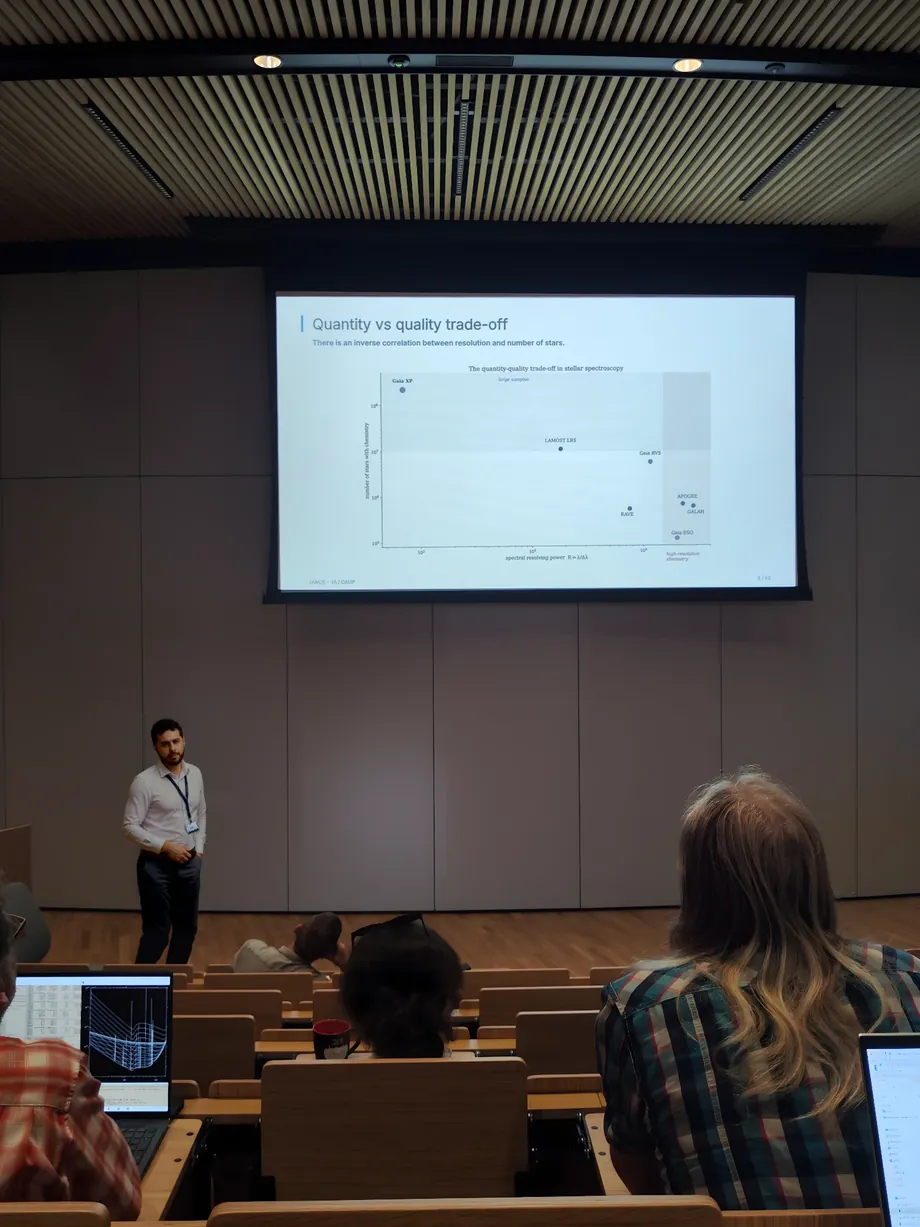
Gaia, APOGEE, GALAH, LAMOST, TESS and Kepler data with PARAM, MESA, GYRE, TRILEGAL, galpy and astropy.