Ariel stellar characterisation. I. Homogeneous stellar parameters of 187 FGK planet host stars
The question
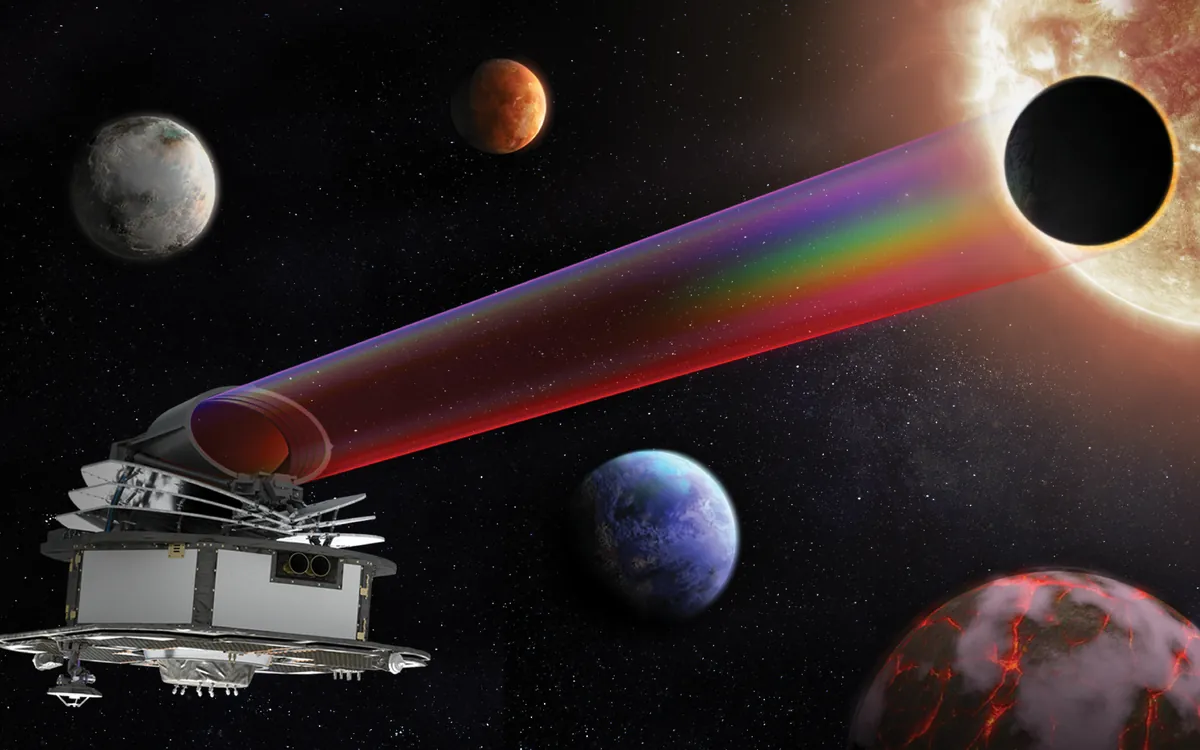
ESA's Ariel mission will study the atmospheres of about a thousand planets around other stars (abstract). It measures each planet's signal as a tiny fraction of its star's light, 10 to 50 parts per million, so every host star has to be characterised first (Sect. 1). Published stellar parameters come from many different methods, and the paper argues that all hosts should be analysed with one uniform technique (abstract).
What the team did
The Ariel consortium's Stellar Characterisation working group applied one method to spectra of 187 known planet hosts of types F, G and K, from the first tier of the mission's target list (Sects. 2 and 3). The method runs three times, Run 0 to Run 2 in the paper: the spectra give temperature and chemical make-up, and from Run 1 on the surface gravity comes from the star's luminosity, built from 2MASS photometry and the Gaia parallax, together with its mass (Sect. 3).
Masses come from isochrone fitting with PARSEC isochrones, using the temperature and metal content from the spectra and that luminosity (Sect. 4). The team checked the method on three star clusters of known age and composition: NGC 2516, NGC 3532 and NGC 6633 (Sect. 5).
What came out
All 187 stars now have temperatures, surface gravities and metal contents from one method, with the tables at the CDS (Appendix A). The average mass uncertainty roughly halves, from 0.21 ± 0.30 to 0.10 ± 0.02 solar masses (abstract, Sect. 4). For 15 per cent of the stars the new mass differs from the published one by 20 to 40 per cent, and for 5 per cent by more than 40 per cent (Sect. 8). Most of the stars belong to the Milky Way's thin disc (Sects. 6.2 and 8).
My part
I joined the consortium's Stellar Characterisation working group (Age, Mass and Radius sub-group) in 2021, during my MSc. For this paper I ran Bayesian stellar characterisation with PARAM for a subset of the sample. PARAM estimates a star's mass, radius and age by comparing its measured properties with a grid of stellar models.