EPRV asteroseismology of the K dwarfs GJ 570 A and GJ 783 A with ESPRESSO
The question
Stars like the Sun ring with sound waves driven by churning gas below the surface, and the tones reveal a star's mass, radius and age. In K dwarfs, smaller and cooler than the Sun, the oscillations move the surface by less than 10 cm/s, and space telescopes have detected them in only a few of these stars (Sect. 1, Fig. 1). Their strength tests the physics of convection and is needed to forecast what the PLATO mission will detect (Sect. 1).
What the team did
The team measured how fast the surfaces of two K dwarfs about 6 parsecs (20 light years) away move towards and away from Earth. ESPRESSO, on ESO's Very Large Telescope in Chile, took a 25-second exposure about once a minute: of GJ 570 A over five nights in May 2024, and of GJ 783 A over six nights in September 2024 (Sect. 2). The team compared the results with 19 other stars, the Sun included, and with 3D simulations of their outer layers (Sect. 5).
What came out
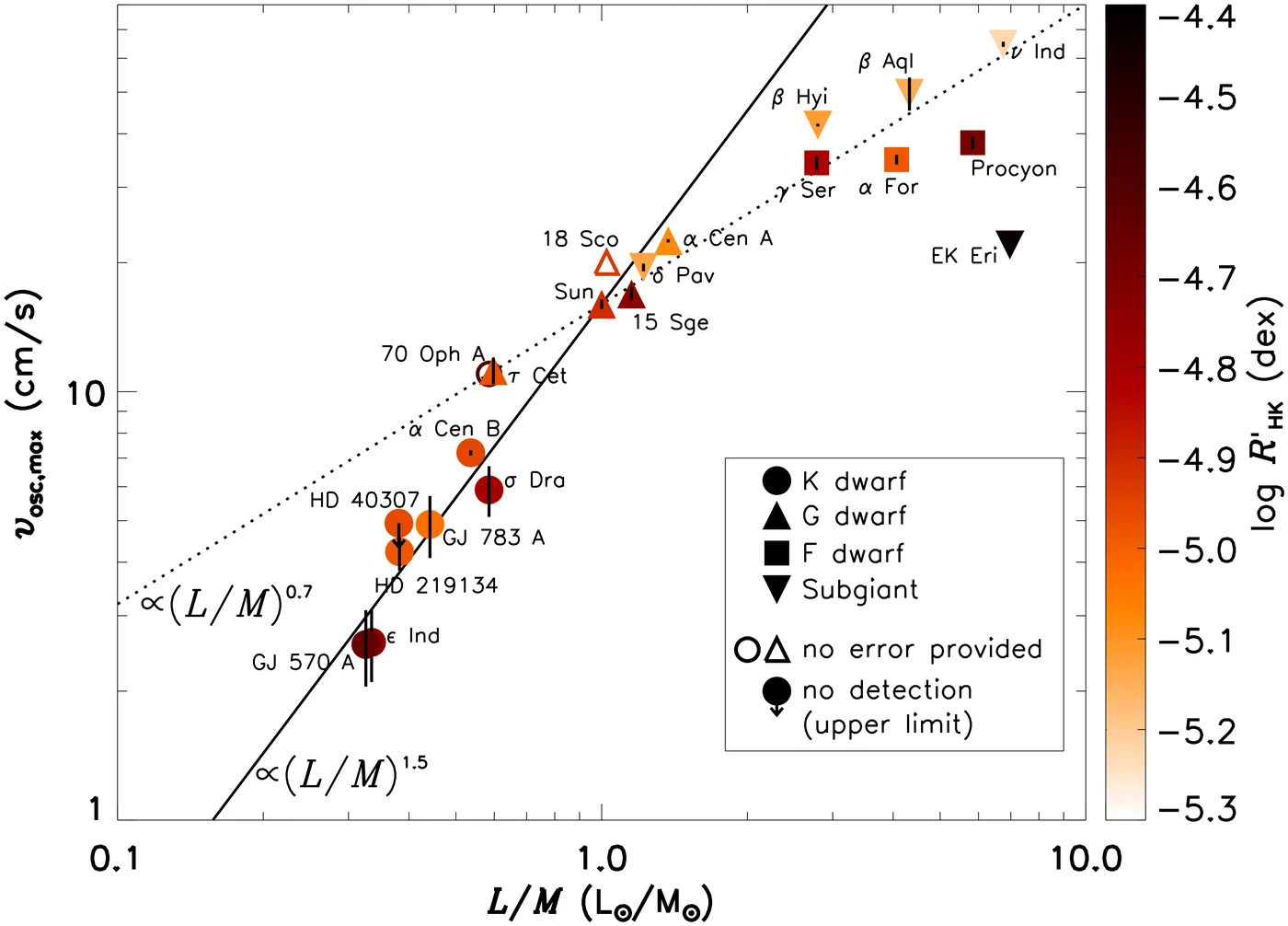
Both stars oscillate, with periods of three to four minutes. The team measured 6 oscillation modes (individual tones) in GJ 570 A and 24 in GJ 783 A, with peak amplitudes of 2.57 ± 0.52 and 4.90 ± 0.81 cm/s, against 16.0 cm/s for the Sun (Sects. 4.1 and 5.1).
Small, cool stars oscillate more weakly than the rule for Sun-like stars predicts. Amplitudes scale as (L/M)0.7 above roughly 5300 K and as (L/M)1.5 below, where L/M is luminosity over mass (Fig. 6). The simulations predict (L/M)0.9 for K dwarfs and miss the drop (Sect. 5.2).
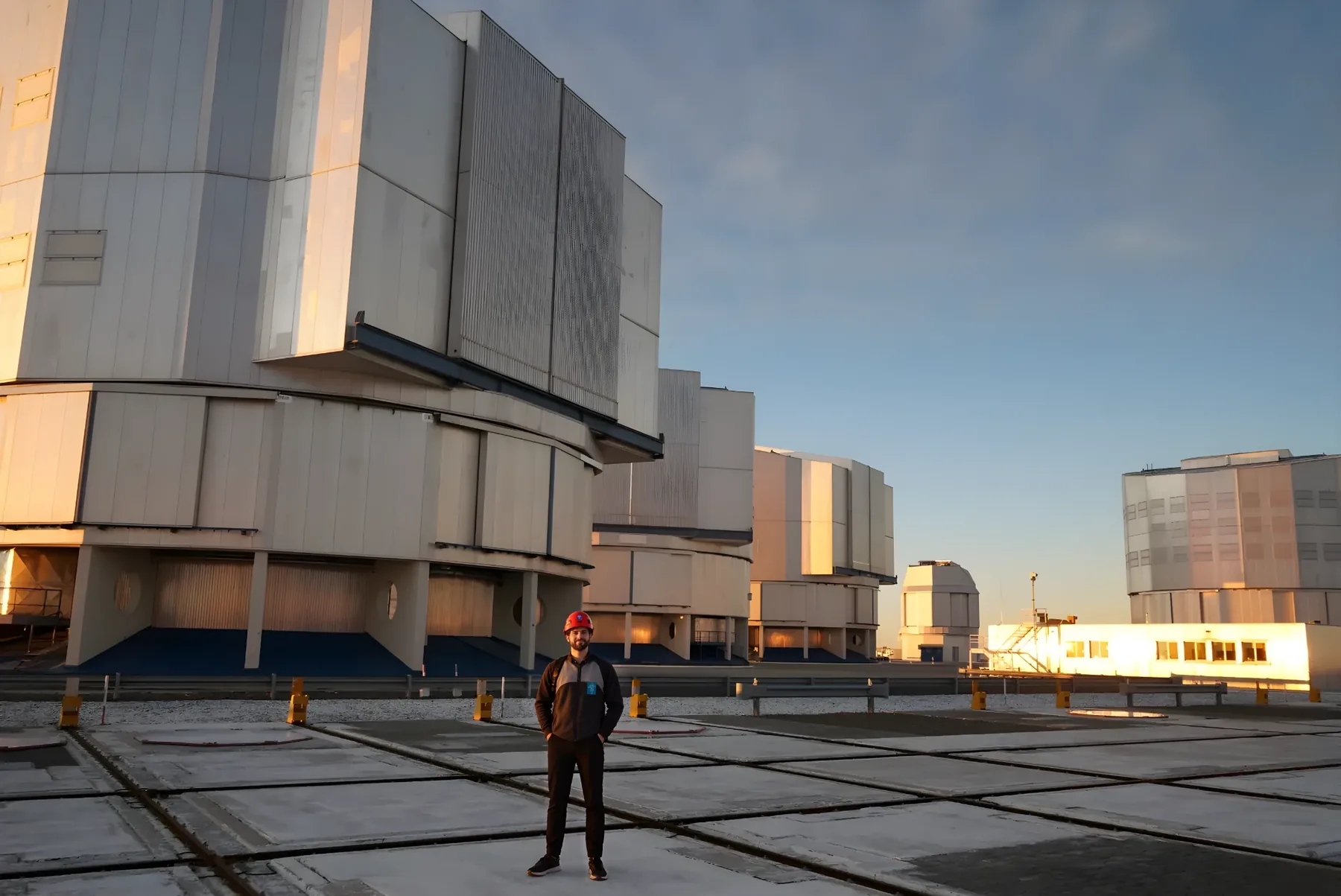
My part
I carried out the GJ 570 A observations in visitor mode, meaning on site at the telescope. I was at ESO's Paranal Observatory from 4 May 2024 and observed from 6 to 12 May on behalf of the principal investigator, Tiago Campante, under his programme 0113.D-0255(B). Wind and overcast skies kept the telescope closed on the first night and for half of the fourth, leaving five usable nights and 2,369 spectra (Sect. 2).