Software

HAYDNsim

A simulation pipeline that builds synthetic stellar fields of crowded clusters and forecasts the photometric noise of each star, written to test the proposed HAYDN mission.

HAYDNsim is a Python package that builds synthetic stellar fields for the proposed ESA HAYDN mission and turns them into per-star inputs for the HAYDN Noise Estimator. It serves the mission proposal, which is described on its own page; this page is about the pipeline. The paper is in preparation, so this page keeps to what the poster and the talk below have already shown.

The HAYDNsim pipeline, in six stagesArchive data from Gaia DR3, HST and four catalogues; a bright-star threshold and membership selection; a King profile normalised to HST; a TRILEGAL population placed by inverse-CDF sampling; the HAYDN Noise Estimator run on Deucalion, which returns a noise-to-signal ratio and a stellar pollution ratio per star; and a seismic performance model. Open clusters and resolved fields skip the profile and population steps.HAYDN, AS PROPOSEDAPERTURE1.2 mFIELD OF VIEW1 degreePLATE SCALE0.5 arcsec per pixelTARGETSto G = 17TARGET FIELDS261 ARCHIVE DATAGaiaHSTHarrisBaumgardtHuntForbesGaia DR3 to G = 18.5, HST photometry of the core,four catalogues2 THRESHOLDGGaiaHSTthe magnitudes where Gaia and HST are bothcomplete; the members3 KING PROFILErfitted to the counts, normalised to HST in the 50to 100 arcsec annulus4 TRILEGAL FIELDTeffLa synthetic population calibrated to the clustermass, placed on the sky5 NOISE ESTIMATORHNE on Deucalion: point spread function, mask andcrowding, per star6 SEISMIC MODELSPR 0.5SPR 0.2isolated2030405060μHzpowerMosser et al. 2019: which stars show oscillationsat that noiseopen clusters skip 3 and 4Creator: Andreas W. Neitzel. © Andreas W. Neitzel. All rights reserved. https://andreaswneitzel.github.io
3 arcsec1 degreetargetneighboursSPR = 0.74light in the mask1″Creator: Andreas W. Neitzel. © Andreas W. Neitzel. All rights reserved. https://andreaswneitzel.github.io

What it does

The pipeline takes a cluster from archive data to a noise forecast for every star in its field, as the schematic above shows stage by stage. In a cluster core the stars overlap, so a large share of the light in any one photometric mask belongs to the neighbours rather than to the target, and that share is what decides whether the mission can measure oscillations there.

I am the sole developer of HAYDNsim. I wrote it during a secondment in A. Miglio's group at INAF-OAS Bologna, between September 2025 and March 2026, and the noise runs were made on Deucalion and on the University of Bologna clusters. The repository is private.
Crowding in seven clustersSeven globular clusters drawn as they fill the one-degree field, at a common angular scale, each from its King profile in the Harris 2010 catalogue, with a bar beneath for the share of its stars whose light is mostly from neighbouring stars: 40 per cent in 47 Tucanae, 36 in NGC 6752 and M54, 12 in M22, 11 in omega Centauri, 7 in NGC 6397 and 3 in M4.STARS WHOSE LIGHT IS MOSTLY THEIR NEIGHBOURS'share with a stellar pollution ratio above 0.5, under each cluster as it fills the one-degree field47 TucNGC 104 · 4.5 kpc40 %NGC 6752NGC 6752 · 4 kpc36 %M54NGC 6715 · 26.5 kpc36 %M22NGC 6656 · 3.2 kpc12 %CenNGC 5139 · 5.2 kpc11 %NGC 6397NGC 6397 · 2.3 kpc7 %M4NGC 6121 · 2.2 kpc3 %Creator: Andreas W. Neitzel. © Andreas W. Neitzel. All rights reserved. https://andreaswneitzel.github.io
The share of each cluster's stars whose light is mostly its neighbours', for the seven globular clusters on the TASC10/KASC17 poster (Neitzel et al. 2026, doi:10.5281/zenodo.23263454). Star positions are schematic; the bars are the poster's values.
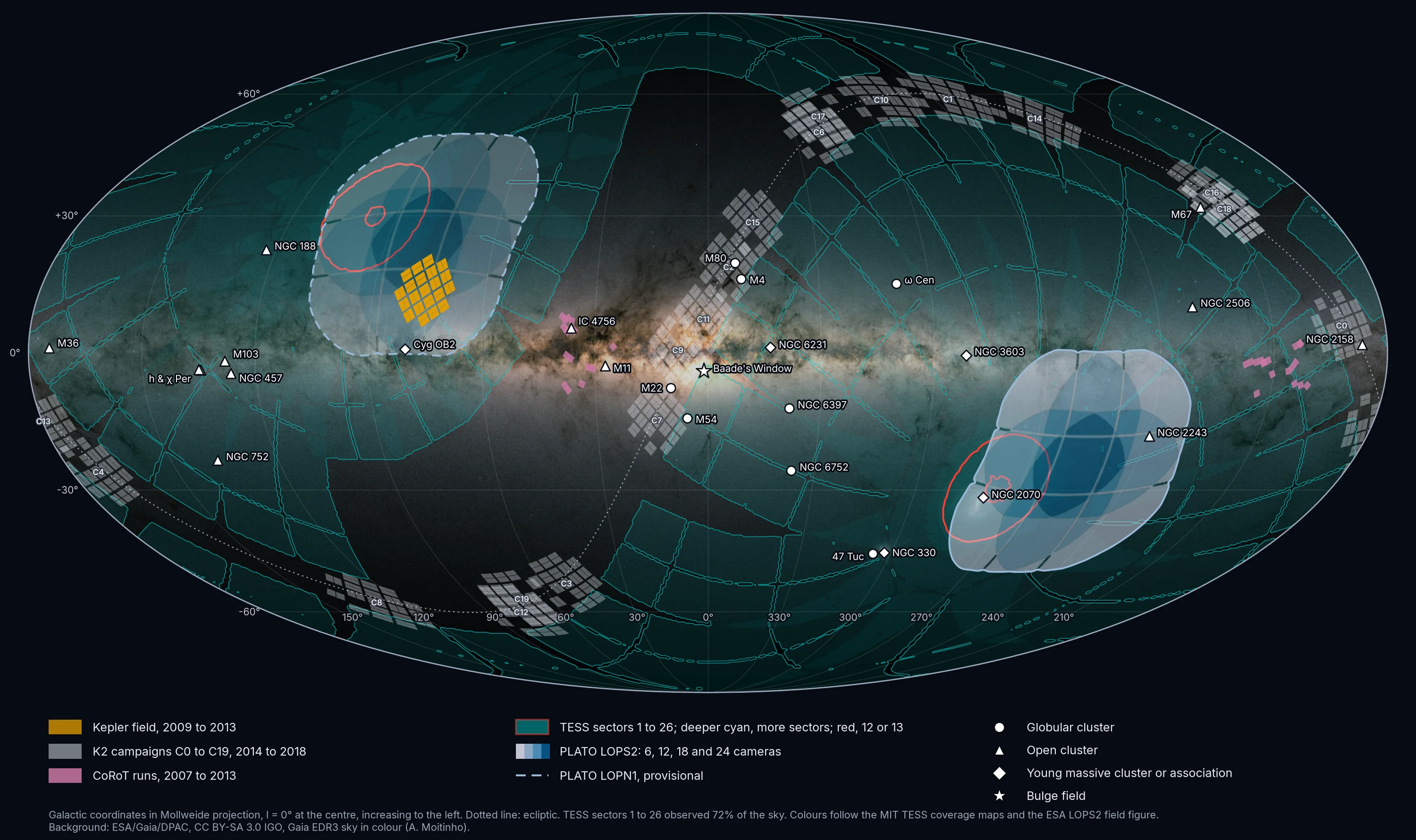
The sky in Galactic coordinates over the Gaia colour map, with the footprints of Kepler, the K2 campaigns, the CoRoT runs, the TESS continuous viewing zones and the PLATO fields, and the candidate HAYDN globular clusters, open clusters, young massive clusters and the bulge field marked and named.
The 26 target fields on the sky in Galactic coordinates, with the fields of earlier and coming missions. Background: ESA/Gaia/DPAC, CC BY-SA 3.0 IGO (acknowledgement A. Moitinho); this figure is shared under the same licence.

Where it was presented

  • Poster, TASC10/KASC17, Aarhus, July 2026: doi:10.5281/zenodo.23263454.
  • Talk, DFA Week 2026, Porto, April 2026: photometric simulations of dense star clusters for HAYDN.
  • The mission itself: What is HAYDN?