Starfold
Finds groups in a table of numbers and tells you how far to trust them.
pip install "starfold @ git+https://github.com/AndreasWNeitzel/starfold"
What Starfold is and is not, how to install it, and a first run on your own table.
UMAP, HDBSCAN and Optuna in plain words, then two full examples from table to report.
What every printed number means, and every function, option and flag.
What it does
Starfold is a Python package for readers who have a table (rows are objects, columns are measurements) and no labels. It combines three existing tools: UMAP (draws a map of the table), HDBSCAN (finds dense clumps on the map) and Optuna (searches the settings of both). It then refits on random subsets of the rows and reports how often each group comes back.
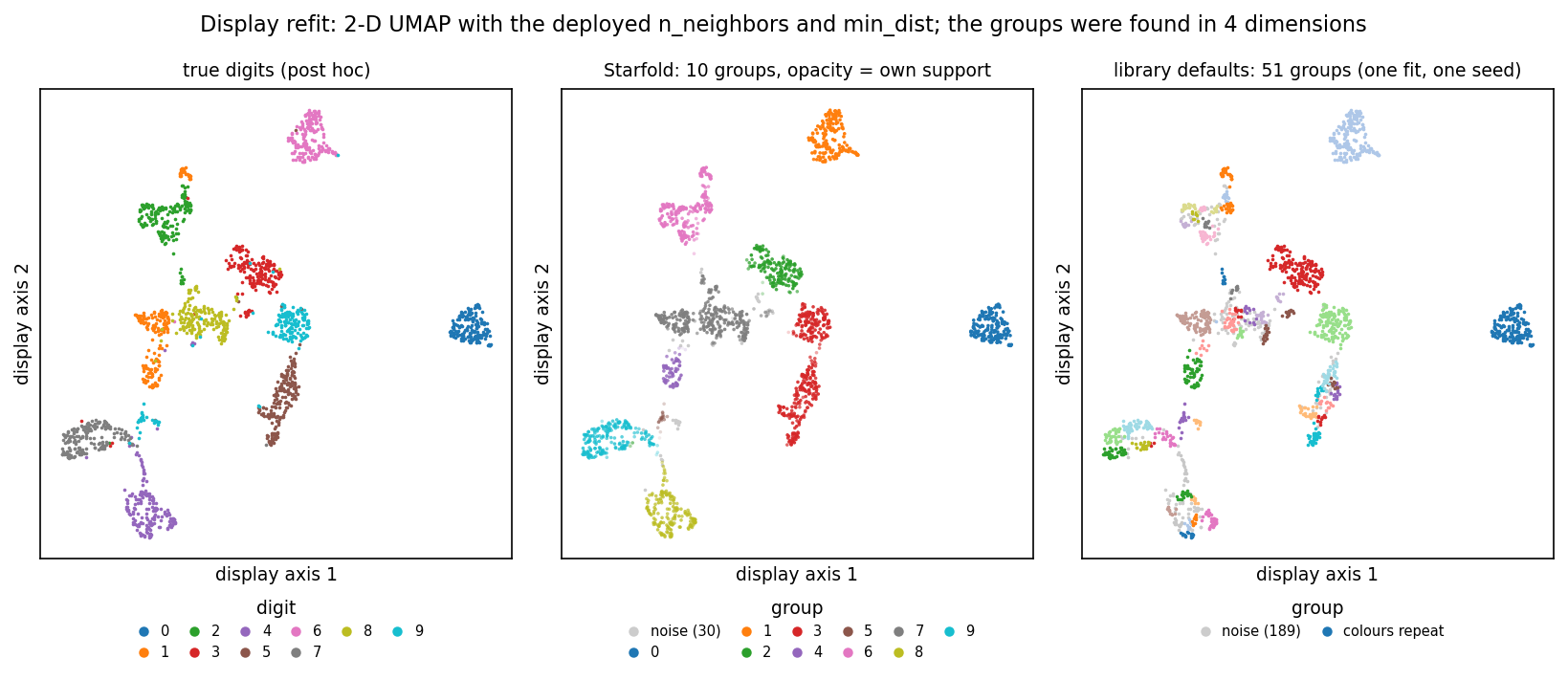
The scikit-learn digits on a two-dimensional map. Left, the true digits, used only as a check after the fit. Middle, the 10 groups Starfold reports, faded where the refits rarely agree. Right, the 51 groups that one fit with the library defaults finds.
Find what you need
You want to |
Go to |
|---|---|
Know what Starfold is and is not |
|
Install it |
|
Run it on a table in 5 lines |
|
Understand UMAP, HDBSCAN and Optuna first |
|
Learn by following a full example |
|
Find what a printed number means |
|
Do one specific task |
|
Look up a function, option or flag |
|
Fix something that looks wrong |
|
Know what you may and may not claim |
|
Look up a word |